Qwiic pinout: GND, 3V3, SDA, SCL
Qwiic uses 4 pins in this order: GND, 3V3, SDA, SCL. SparkFun's solderless 4-pin JST-SH system. Strictly 3.3 V, polarized, and chainable.
Pinout
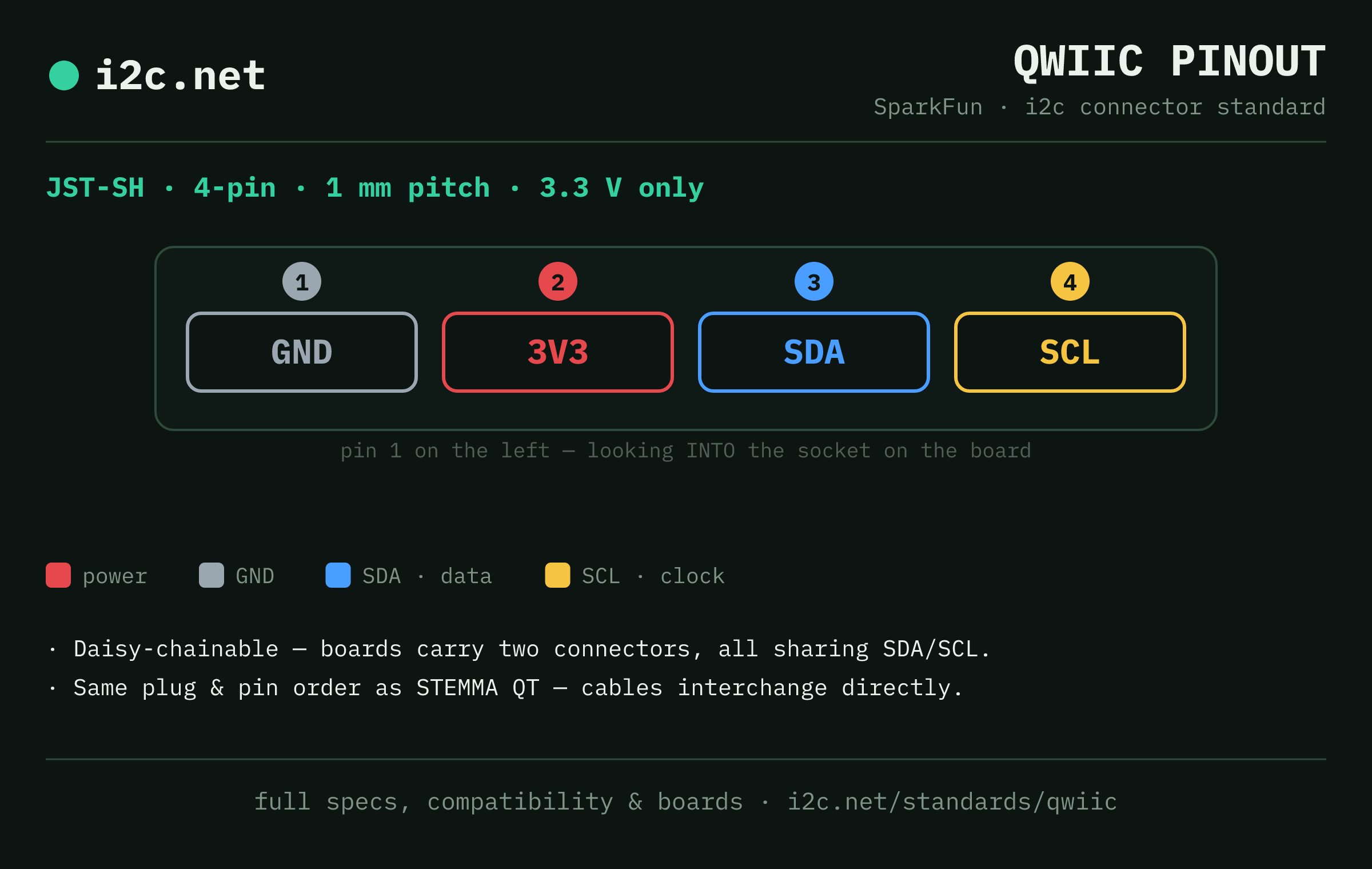
Qwiic pinout
Qwiic runs a 4-pin JST-SH at 1 mm pitch, wired GND → 3V3 → SDA → SCL looking into the socket. The pin order is the part that actually matters: a connector that physically fits but is wired differently will land SDA where SCL should be, and the bus simply goes quiet. Because STEMMA QT use the same connector and the same order, their cables cross over with nothing in between.
Specs
Qwiic at a glance
| Vendor | SparkFun |
|---|---|
| Connector | JST-SH |
| Pins | 4 |
| Pitch | 1 mm |
| Logic voltage | 3.3 V only |
| Chainable | yes |
| Interrupt pin | no |
| Official docs | SparkFun's Qwiic documentation ↗ |
Watch out: 3.3 V only — a 5 V host can damage a Qwiic device without a level shifter.
Voltage & chaining
Living with Qwiic on a real bus
Qwiic is 3.3 V only. That single fact causes most of the damage people do to these chains: a 5 V host will happily drive 5 V into 3.3 V-only parts. If your board is an Arduino Uno rather than a Pi or ESP32, put a level shifter in first.
Chaining is the point of Qwiic: two connectors per board, so you hop from one to the next and they all share SDA and SCL. Two things end the party — two boards answering the same address (see address conflicts for the fixes), and the pull-ups. Every board adds its own pull-up resistors in parallel with the rest, so a long chain drives the combined resistance down toward the point where the bus can't pull low cleanly.
Cable length is the other quiet limit — i2c budgets 400 pF of total bus capacitance, and every extra centimetre spends it. Inside an enclosure you'll never notice; if you're reaching across a room, read how far i2c actually goes first. If a chain stops responding, an i2c scan tells you whether it's a wiring or an addressing problem.
Compatibility
Connecting Qwiic to other standards
Every pairing below is pre-answered — whether it's a direct cable, an adapter, or a level shifter first. Or skip to the compatibility checker and pick both ends.
Boards
Boards that ship with Qwiic
23 boards in our dataset ship with Qwiic — plug-together, no soldering. Each page lists its i2c address, voltage range and wiring notes.
Questions
Qwiic FAQ
What connector does Qwiic use?
A 4-pin JST-SH at 1 mm pitch, wired GND / 3V3 / SDA / SCL. That's the same physical connector and pin order as STEMMA QT, so cables interchange directly.
What voltage does Qwiic run at?
3.3 V only. Feeding 5 V into a Qwiic chain can damage the boards on it — if your host is a 5 V Arduino, level-shift first.
Can you daisy-chain Qwiic?
Yes — Qwiic boards carry two connectors, so you chain one to the next and every device shares the same SDA/SCL. Two limits bite eventually: each board must have a unique address, and every board adds pull-up resistors in parallel plus cable capacitance.
Does Qwiic have an interrupt pin?
No. Qwiic carries only power, ground, SDA and SCL. A sensor with an interrupt output needs that pin wired separately to a spare GPIO — i2c itself has no way to signal "data ready" on the bus.
What should I watch out for with Qwiic?
3.3 V only — a 5 V host can damage a Qwiic device without a level shifter.