VL53L0X — i2c address & wiring
Time-of-flight laser distance sensor, up to ~2 m.
Key facts
VL53L0X at a glance
| i2c address | 0x29 fixed address |
|---|---|
| Logic voltage | 3.3–5 V |
| Type | sensor |
| Part | ST VL53L0X |
| Ships with | Qwiic, STEMMA QT |
| Datasheet | ST VL53L0X — manufacturer documentation ↗ |
The chip
What the ST VL53L0X actually is
Laser time-of-flight (ToF) distance sensor measuring absolute distance using infrared laser pulses. Provides accurate short-range ranging with far less sensitivity to target colour and ambient light than traditional IR proximity sensors, though surface reflectivity still affects maximum range.
Watch out: Every unit boots at 0x29 with no address pins — to run several, hold each in reset via its XSHUT pin and assign new addresses one at a time at startup, or put them behind a TCA9548A multiplexer.
Wiring
How to connect the VL53L0X
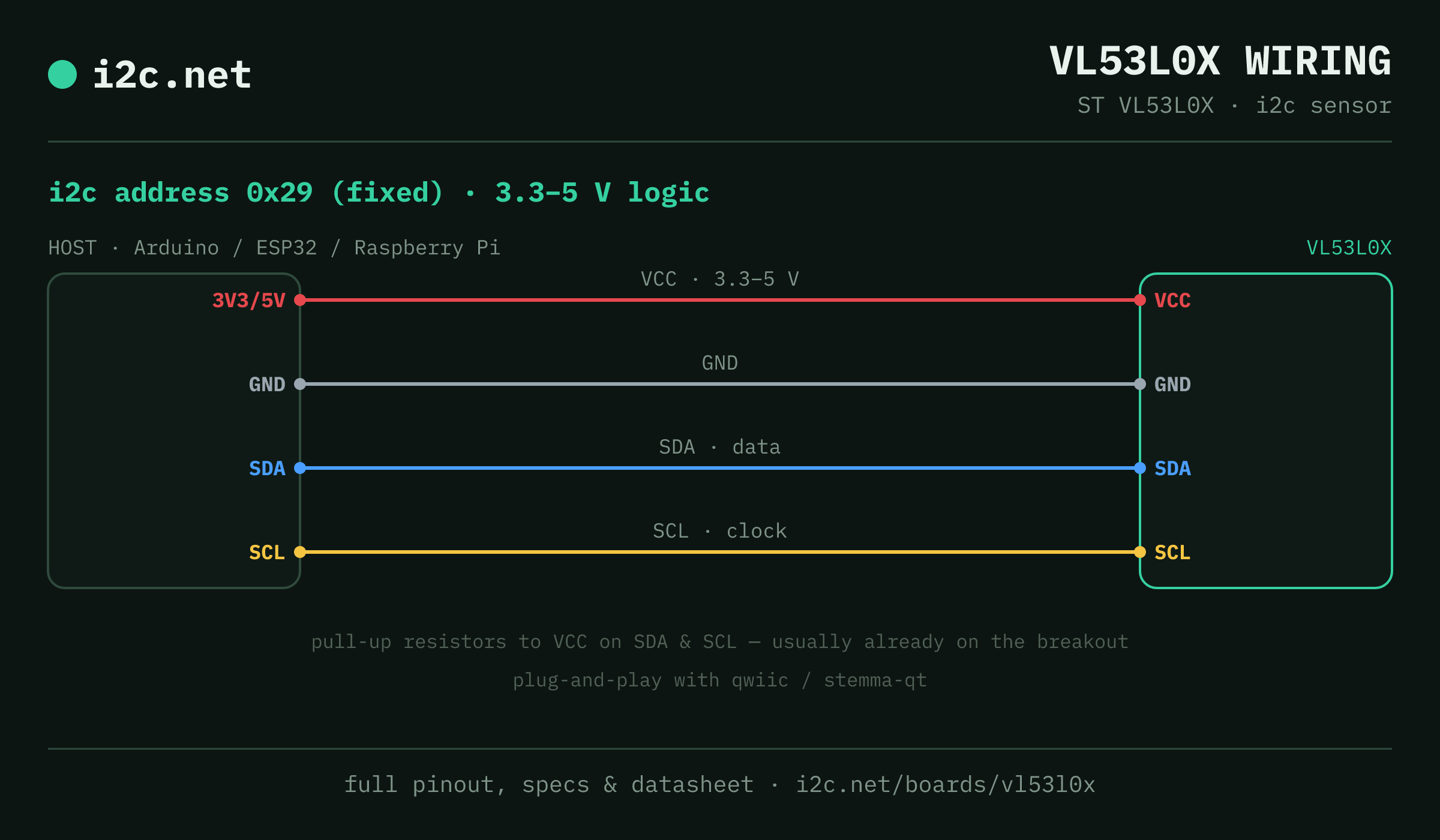
The VL53L0X talks i2c at address 0x29. It runs at 3.3–5 V, so match your host's logic level — if your host is 5 V and a board on the bus is 3.3 V-only, add a level shifter. Use the compatibility checker to confirm the exact cable for your setup.
The address is fixed, so two VL53L0Xs can't share a bus directly — the address-conflict guide covers the workarounds (multiplexer, second bus).
Wiring is the usual four: power, ground, SDA and SCL, plus pull-up resistors — almost always already fitted on the breakout. Nothing showing up? Run an i2c scanner first; if the bus is silent, the 7-step checklist finds it faster than guessing.
Ecosystems
Plug-together options for the VL53L0X
VL53L0X breakouts ship with Qwiic and STEMMA QT — keyed 4-pin cables carrying power, ground, SDA and SCL, so there's nothing to solder and nothing to wire backwards. Chain it to the next board and keep going.
Running a mixed bench? Those ecosystems interoperate more than their marketing suggests — see every connector pairing for the cable or adapter you need, or the standards overview for how they compare.
Go deeper
Guides covering the VL53L0X
Alternatives
Other distance boards
Get one
Questions
VL53L0X i2c FAQ
What is the VL53L0X's i2c address?
The VL53L0X sits at a fixed address of 0x29. It can't be changed, so two of them can't share one bus without a multiplexer or a second bus.
What voltage does the VL53L0X run at?
3.3–5 V logic. That range covers both 3.3 V and 5 V hosts, so it drops onto a Pi, ESP32 or Arduino without a level shifter.
Can I use two VL53L0Xs on one i2c bus?
Not directly — every VL53L0X answers to 0x29, so two on one bus would collide. Use a TCA9548A multiplexer to give each its own channel, or put the second one on a separate bus.
Does the VL53L0X work with Qwiic and STEMMA QT?
Yes — VL53L0X breakouts ship with Qwiic / STEMMA QT, so it plugs straight in with no soldering. Mixing ecosystems? The compatibility checker gives you the exact cable or adapter.
What should I watch out for with the VL53L0X?
Every unit boots at 0x29 with no address pins — to run several, hold each in reset via its XSHUT pin and assign new addresses one at a time at startup, or put them behind a TCA9548A multiplexer.