DRV2605L — i2c address & wiring
Haptic motor driver for ERM and LRA vibration motors, with a built-in effect library.
Key facts
DRV2605L at a glance
| i2c address | 0x5A fixed address |
|---|---|
| Logic voltage | 2.5–5.2 V |
| Type | driver |
| Part | TI DRV2605L |
| Ships with | generic modules — plain 0.1″ headers, no connector system |
| Datasheet | TI DRV2605L — manufacturer documentation ↗ |
The chip
What the TI DRV2605L actually is
Drives both ERM (eccentric-mass) and LRA (linear-resonant) vibration motors with closed-loop control, including automatic LRA resonance tracking. Ships with a licensed library of 123 pre-built haptic effects — clicks, buzzes, ramps — triggered by index over i2c, plus a real-time mode for streaming raw amplitude and an audio-to-vibration mode.
Watch out: The address is fixed at 0x5A with no strap to change it — and 0x5A is crowded: the MLX90614 IR thermometer sits there, as do the MPR121 touch controller and the CCS811 air sensor. Any of those pairings (or two DRV2605Ls) needs a multiplexer or a second bus. Also match the ERM/LRA mode to the motor you actually wired: effects tuned for one feel wrong or do nothing on the other.
Wiring
How to connect the DRV2605L
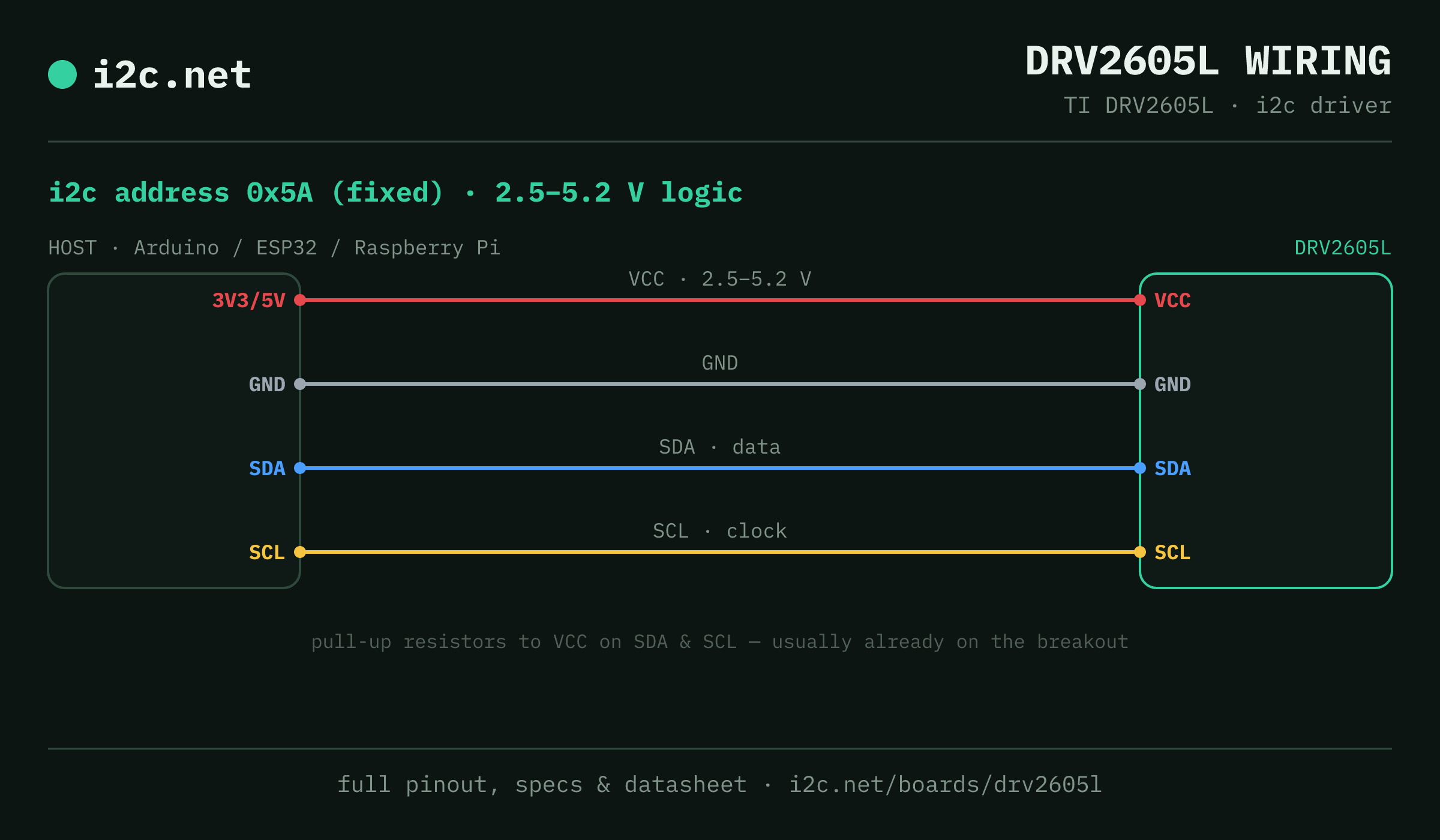
The DRV2605L talks i2c at address 0x5A. It runs at 2.5–5.2 V, so match your host's logic level — if your host is 5 V and a board on the bus is 3.3 V-only, add a level shifter. Use the compatibility checker to confirm the exact cable for your setup.
The address is fixed, so two DRV2605Ls can't share a bus directly — the address-conflict guide covers the workarounds (multiplexer, second bus).
Wiring is the usual four: power, ground, SDA and SCL, plus pull-up resistors — almost always already fitted on the breakout. Nothing showing up? Run an i2c scanner first; if the bus is silent, the 7-step checklist finds it faster than guessing.
Go deeper
Guides covering the DRV2605L
Alternatives
Other i2c drivers
Watch the bus
Boards that clash with the DRV2605L
These want an address the DRV2605L also answers (0x5A), so they can't share a bus with it untouched. If one is address-selectable, strap it elsewhere; if not, the conflict guide covers the multiplexer and second-bus routes, and the collision roundup explains why a scan won't warn you.
Get one
Questions
DRV2605L i2c FAQ
What is the DRV2605L's i2c address?
The DRV2605L sits at a fixed address of 0x5A. It can't be changed, so two of them can't share one bus without a multiplexer or a second bus.
What voltage does the DRV2605L run at?
2.5–5.2 V logic. That range covers both 3.3 V and 5 V hosts, so it drops onto a Pi, ESP32 or Arduino without a level shifter.
Can I use two DRV2605Ls on one i2c bus?
Not directly — every DRV2605L answers to 0x5A, so two on one bus would collide. Use a TCA9548A multiplexer to give each its own channel, or put the second one on a separate bus.
Does the DRV2605L come as a plug-together breakout?
Not in the mainstream connector ecosystems — DRV2605L modules are generic boards with 0.1″ headers, so you'll be soldering headers and running jumper wires to SDA, SCL, power and ground.
What should I watch out for with the DRV2605L?
The address is fixed at 0x5A with no strap to change it — and 0x5A is crowded: the MLX90614 IR thermometer sits there, as do the MPR121 touch controller and the CCS811 air sensor. Any of those pairings (or two DRV2605Ls) needs a multiplexer or a second bus. Also match the ERM/LRA mode to the motor you actually wired: effects tuned for one feel wrong or do nothing on the other.