Gravity pinout: VCC, GND, SCL, SDA
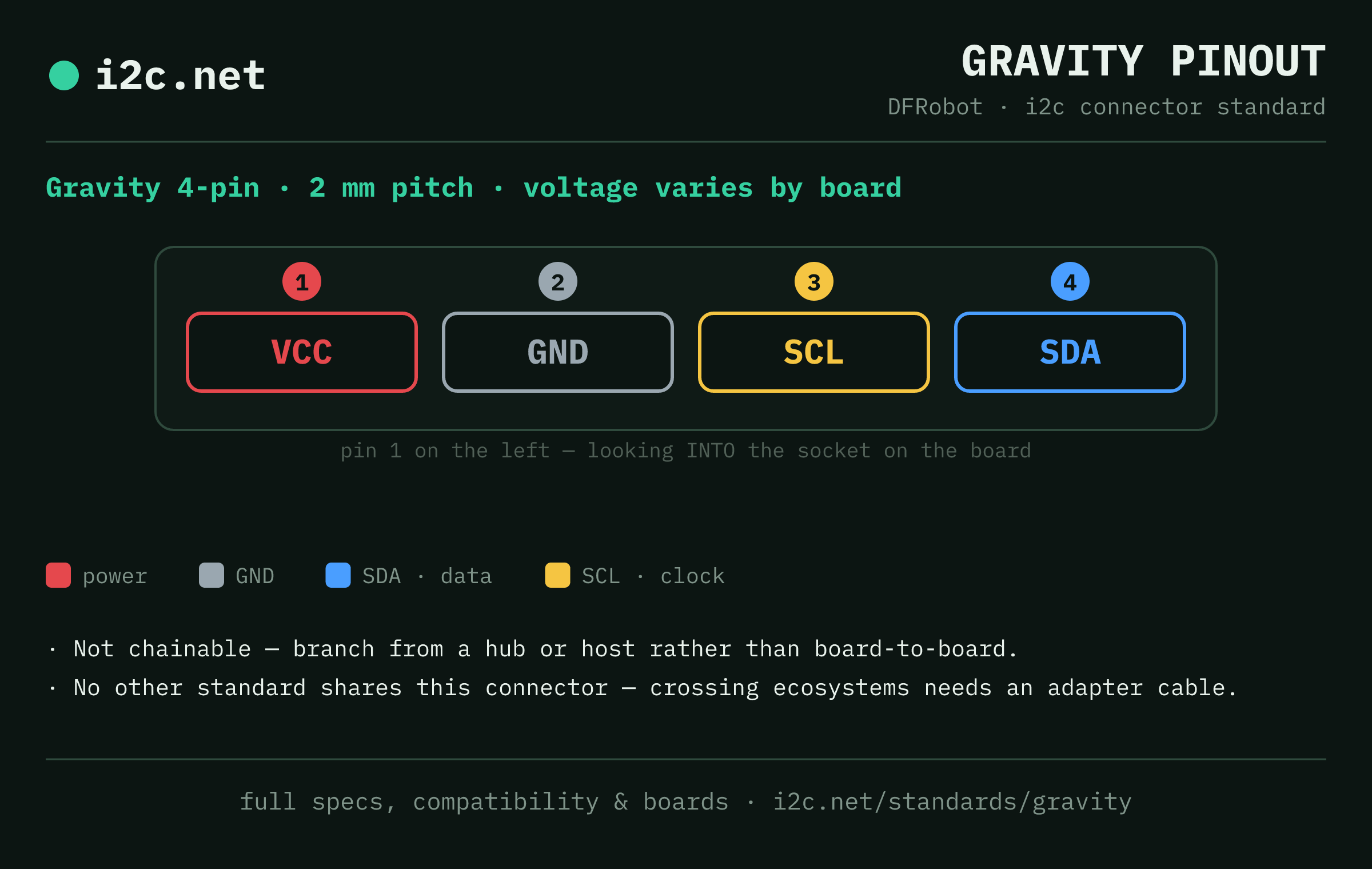
Gravity uses 4 pins in this order: VCC, GND, SCL, SDA. DFRobot's 4-pin system (red VCC, black GND, blue SCL, green SDA). Every pin sits in a different spot than Qwiic.
Pinout
Gravity pinout
Gravity runs a 4-pin Gravity 4-pin at 2 mm pitch, wired VCC → GND → SCL → SDA looking into the socket. The pin order is the part that actually matters: a connector that physically fits but is wired differently will land SDA where SCL should be, and the bus simply goes quiet. Compare it against the others in the pinout visualizer before you trust a cable that merely fits.
Specs
Gravity at a glance
| Vendor | DFRobot |
|---|---|
| Connector | Gravity 4-pin |
| Pins | 4 |
| Pitch | 2 mm |
| Logic voltage | varies by board |
| Chainable | no |
| Interrupt pin | no |
| Official docs | DFRobot's Gravity documentation ↗ |
Watch out: Every pin differs from Qwiic: power and ground are reversed (a blind swap can reverse power and damage the board), and SDA/SCL are swapped too. Use a proper adapter and verify before applying power.
Voltage & chaining
Living with Gravity on a real bus
Gravity is varies by board. Voltage varies by board here, so the ecosystem gives you no guarantee — read each board's spec, and see the level-shifting guide when mixing rails.
Gravity boards aren't built to chain board-to-board, so you branch from a hub or the host instead of running them in series. That keeps the pull-up maths simpler, at the cost of more wiring back to one point.
Cable length is the other quiet limit — i2c budgets 400 pF of total bus capacitance, and every extra centimetre spends it. Inside an enclosure you'll never notice; if you're reaching across a room, read how far i2c actually goes first. If a chain stops responding, an i2c scan tells you whether it's a wiring or an addressing problem.
Compatibility
Connecting Gravity to other standards
Every pairing below is pre-answered — whether it's a direct cable, an adapter, or a level shifter first. Or skip to the compatibility checker and pick both ends.
Boards
Boards that ship with Gravity
3 boards in our dataset ship with Gravity — plug-together, no soldering. Each page lists its i2c address, voltage range and wiring notes.
Questions
Gravity FAQ
What connector does Gravity use?
A 4-pin Gravity 4-pin at 2 mm pitch, wired VCC / GND / SCL / SDA. The pin order matters as much as the plug — a connector that fits but is wired differently will swap SDA and SCL.
What voltage does Gravity run at?
varies by board. Check the individual board, because the standard itself doesn't pin this down.
Can you daisy-chain Gravity?
Not by design — Gravity boards aren't built to chain board-to-board, so you branch from a hub or host instead of running them in series.
Does Gravity have an interrupt pin?
No. Gravity carries only power, ground, SDA and SCL. A sensor with an interrupt output needs that pin wired separately to a spare GPIO — i2c itself has no way to signal "data ready" on the bus.
What should I watch out for with Gravity?
Every pin differs from Qwiic: power and ground are reversed (a blind swap can reverse power and damage the board), and SDA/SCL are swapped too. Use a proper adapter and verify before applying power.