SHT31 — i2c address & wiring
High-accuracy temperature and humidity, industrial-grade repeatability.
Key facts
SHT31 at a glance
| i2c address | 0x440x45 address-selectable via pins/jumpers |
|---|---|
| Logic voltage | 3.3–5 V |
| Type | sensor |
| Part | Sensirion SHT31 |
| Ships with | STEMMA QT, Grove |
| Datasheet | Sensirion SHT31 — manufacturer documentation ↗ |
The chip
What the Sensirion SHT31 actually is
Digital temperature and humidity sensor providing fully calibrated measurements with high repeatability, good long-term stability and low power consumption. Widely used for environmental monitoring and HVAC applications.
Wiring
How to connect the SHT31
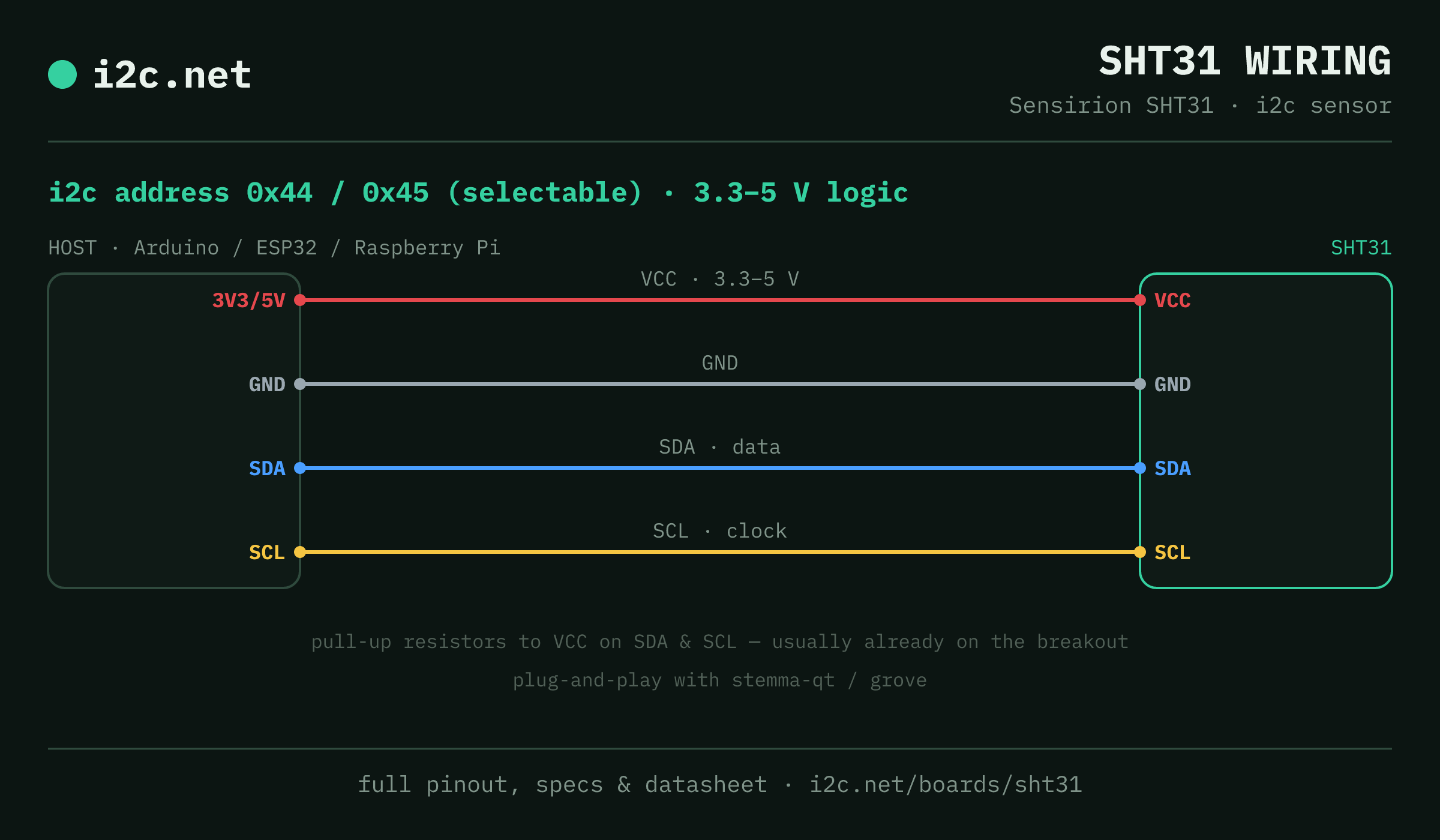
The SHT31 talks i2c at address 0x44 (up to 2 selectable addresses, handy when you need more than one on the same bus). It runs at 3.3–5 V, so match your host's logic level — if your host is 5 V and a board on the bus is 3.3 V-only, add a level shifter. Use the compatibility checker to confirm the exact cable for your setup.
Because the address is selectable, you can run several SHT31 boards on one bus by setting each to a different address — no extra wiring beyond the shared SDA/SCL.
Wiring is the usual four: power, ground, SDA and SCL, plus pull-up resistors — almost always already fitted on the breakout. Nothing showing up? Run an i2c scanner first; if the bus is silent, the 7-step checklist finds it faster than guessing.
Ecosystems
Plug-together options for the SHT31
SHT31 breakouts ship with STEMMA QT and Grove — keyed 4-pin cables carrying power, ground, SDA and SCL, so there's nothing to solder and nothing to wire backwards. Chain it to the next board and keep going.
Running a mixed bench? Those ecosystems interoperate more than their marketing suggests — see every connector pairing for the cable or adapter you need, or the standards overview for how they compare.
Alternatives
Other environmental boards
Watch the bus
Boards that clash with the SHT31
These want addresses the SHT31 also answers (0x44, 0x45), so they can't share a bus with it untouched. If one is address-selectable, strap it elsewhere; if not, the conflict guide covers the multiplexer and second-bus routes, and the collision roundup explains why a scan won't warn you.
Get one
Questions
SHT31 i2c FAQ
What is the SHT31's i2c address?
The SHT31 uses 0x44 or 0x45, selected with an address pin or solder jumper on the board. If a scan turns up something unexpected, our i2c address list names the usual suspect for every address.
What voltage does the SHT31 run at?
3.3–5 V logic. That range covers both 3.3 V and 5 V hosts, so it drops onto a Pi, ESP32 or Arduino without a level shifter.
Can I use two SHT31s on one i2c bus?
Yes — set each one to a different address (0x44, 0x45) using its address pin or jumper, then wire both to the same SDA/SCL. That gives you up to 2 on a single bus before you need a multiplexer.
Does the SHT31 work with STEMMA QT and Grove?
Yes — SHT31 breakouts ship with STEMMA QT / Grove, so it plugs straight in with no soldering. Mixing ecosystems? The compatibility checker gives you the exact cable or adapter.