TPA2016D2 — i2c address & wiring
Stereo class-D amplifier with i2c volume, AGC and limiter control.
Key facts
TPA2016D2 at a glance
| i2c address | 0x58 fixed address |
|---|---|
| Logic voltage | 2.5–5.5 V |
| Type | audio amp |
| Part | TI TPA2016D2 |
| Ships with | generic modules — plain 0.1″ headers, no connector system |
| Datasheet | TI TPA2016D2 — manufacturer documentation ↗ |
The chip
What the TI TPA2016D2 actually is
Stereo class-D audio amplifier with i2c control over gain, automatic gain control (AGC), limiting and compression — the volume knob and dynamics processing are registers instead of trim pots. Drives small speakers directly for projects that need configurable sound.
Wiring
How to connect the TPA2016D2
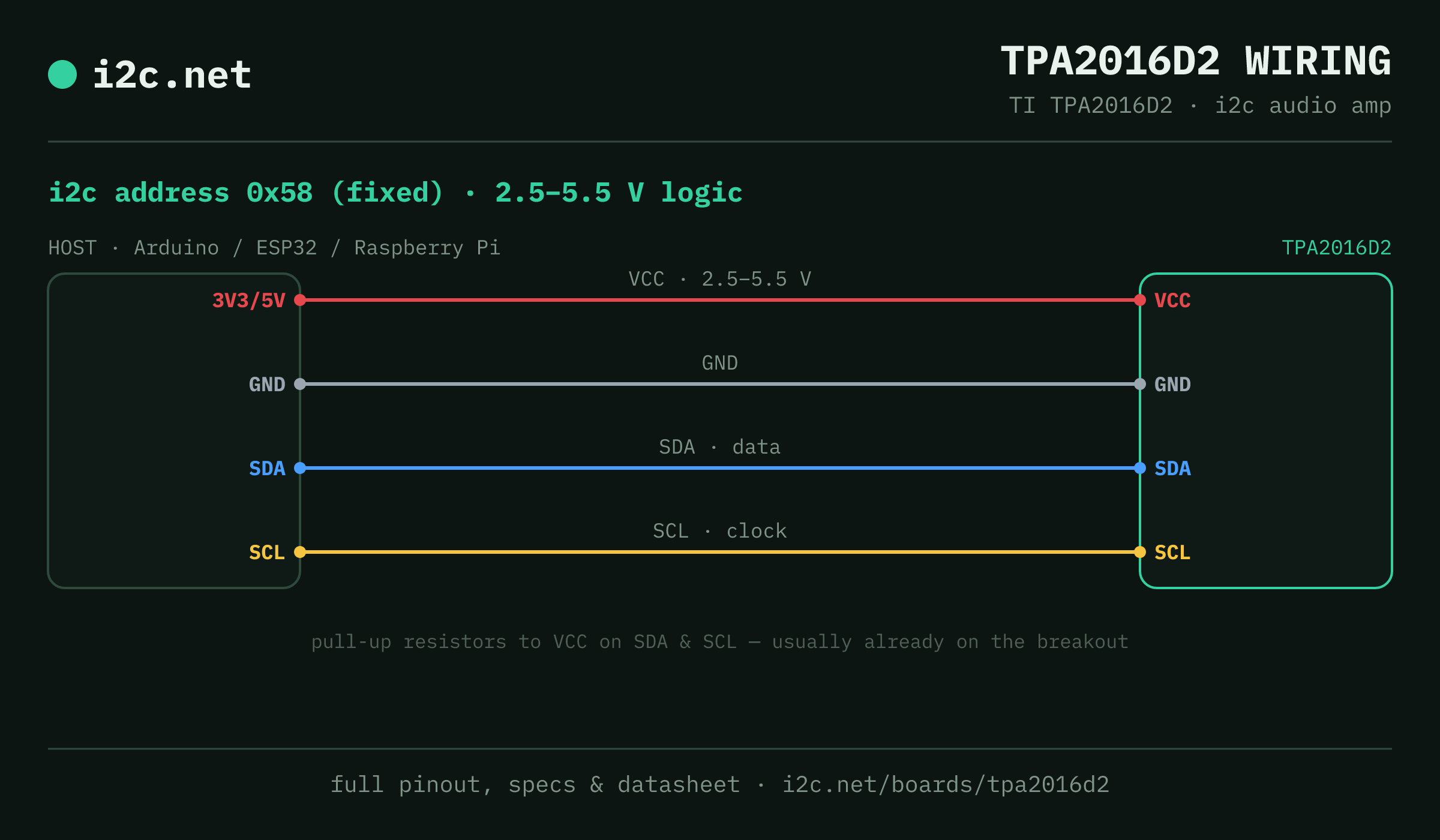
The TPA2016D2 talks i2c at address 0x58. It runs at 2.5–5.5 V, so match your host's logic level — if your host is 5 V and a board on the bus is 3.3 V-only, add a level shifter. Use the compatibility checker to confirm the exact cable for your setup.
The address is fixed, so two TPA2016D2s can't share a bus directly — the address-conflict guide covers the workarounds (multiplexer, second bus).
Wiring is the usual four: power, ground, SDA and SCL, plus pull-up resistors — almost always already fitted on the breakout. Nothing showing up? Run an i2c scanner first; if the bus is silent, the 7-step checklist finds it faster than guessing.
Get one
Questions
TPA2016D2 i2c FAQ
What is the TPA2016D2's i2c address?
The TPA2016D2 sits at a fixed address of 0x58. It can't be changed, so two of them can't share one bus without a multiplexer or a second bus.
What voltage does the TPA2016D2 run at?
2.5–5.5 V logic. That range covers both 3.3 V and 5 V hosts, so it drops onto a Pi, ESP32 or Arduino without a level shifter.
Can I use two TPA2016D2s on one i2c bus?
Not directly — every TPA2016D2 answers to 0x58, so two on one bus would collide. Use a TCA9548A multiplexer to give each its own channel, or put the second one on a separate bus.
Does the TPA2016D2 come as a plug-together breakout?
Not in the mainstream connector ecosystems — TPA2016D2 modules are generic boards with 0.1″ headers, so you'll be soldering headers and running jumper wires to SDA, SCL, power and ground.